Affiliate disclosure: This review contains affiliate links. Belmont Figgis may earn a commission if you make a purchase through them, at no added cost to you. Compensation does not purchase the conclusion.
A scene can deliver what it promised and still need an editor. “Staying Sharp” spends its long runtime proving both points.
Katana Black gives the production its reason to exist. She brings confidence, expressive reactions, and a steady awareness of the lens. Ryan Madison gives her a partner strong enough to match the physical work without trying to seize the scene from her.
The scene looks warm, clean, and expensive. It also runs past several natural stopping points. Katana keeps it alive when the edit does not.

Katana Enters Before the Scene Does
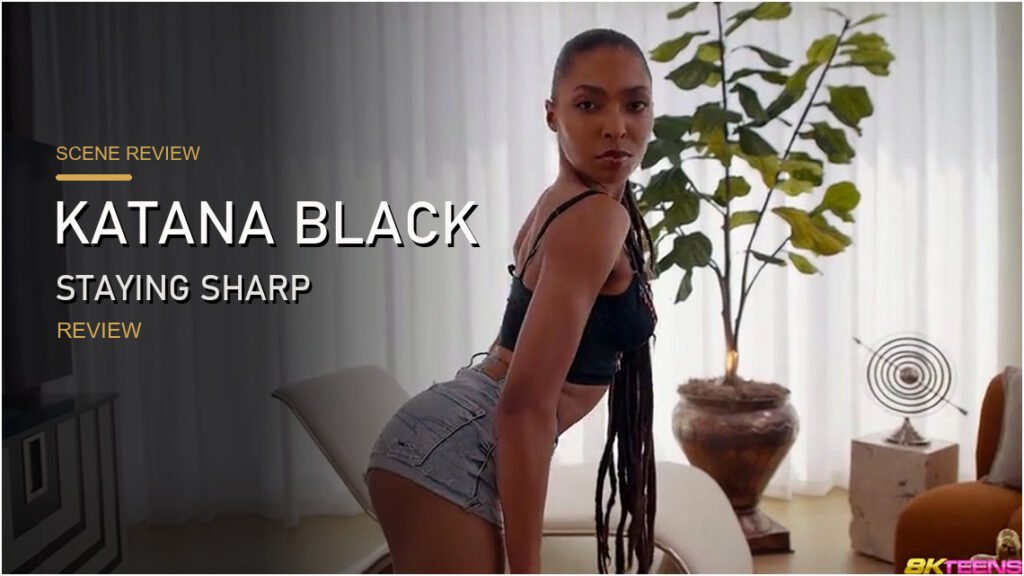
Katana begins alone on a cream chaise in a black floral top, denim shorts, and red wedge heels. The wardrobe gives the tease a clear shape. The heels add danger. The denim keeps the room casual. The floral top bridges the two.
She does not wait for the action to give her something to perform. She uses posture, eye contact, and small changes in expression to establish control. The camera becomes part of the encounter before Madison enters the frame.
This matters because the scene has almost no story. Katana supplies the missing structure. Her tease creates the opening. Her reactions create the transitions. Her presence gives the long middle a center.

Chemistry Needs Faces
When Madison joins her, the scene changes from display to contact. Kissing, touch, eye contact, and shared timing make the shift feel earned. Their responses connect one position to the next, which keeps the encounter from becoming a list of acts performed in order.
Madison understands his function. He brings force and commitment, then leaves the center of the frame open for Katana. His restraint helps her performance. The scene belongs to her, but it does not feel solitary.
The wider compositions capture this dynamic. They preserve both faces, show the exchange of attention, and let body language carry part of the scene. Medium two-shots work for the same reason.
Several close-ups do the opposite. They provide explicit detail but cut away the reactions that give the detail meaning. The camera records more anatomy and less chemistry. “Staying Sharp” loses personality whenever it forgets that the performers have faces.

Variety Cannot Replace Momentum
The scene offers range. Oral attention, standing work, face-to-face positions, woman-on-top sequences, and rear-entry variations change the performers’ posture and the camera’s options. The production moves between the cream chaise and an orange sofa, then returns to the chaise near the end.
Those changes prevent visual monotony. They do not solve the pacing.
Several chair and sofa passages continue after the performers have found their strongest beat. The edit waits for the next position instead of shaping the current one. Momentum returns when Katana and Madison reconnect through a kiss, change their level in the room, or move to new furniture.
Viewers who want an extended showcase may treat the length as value. I wanted the scene to recognize when it had already made its point. Ten fewer minutes could have made the remaining minutes feel larger.

The Room Does Real Work
Light through sheer curtains wraps the room without flattening it. The cream chaise, orange upholstery, plants, and sculptural décor create enough contrast to separate bodies from the background. The warm palette suits Katana and gives the set an identity beyond “living room.”
The camera uses wide frames, medium coverage, low angles, overhead views, side angles, and tight detail. The mix gives held positions some movement. The wide shots remain the best images because they let performance and action occupy the same frame.
The ending makes the strangest choice. A black logo card interrupts the scene. The video then returns for a brief solo pose from Katana and stops five seconds later. The extra image should feel like an encore. Instead, it feels like someone reopened the file after export and forgot to close it again.

Final Verdict
“Staying Sharp” works because Katana Black understands the lens. Her gaze, reactions, and physical confidence give the scene a clear identity. Madison supports the performance, and the room gives both performers a polished stage.
The scene also confuses duration with development. Repetitive passages soften the middle. Tight close-ups hide the chemistry. The interrupted final beat denies the production a clean exit.
None of those choices erase Katana’s command of the frame. They explain why a strong showcase stops short of a top score.
Rating: 4 out of 5
Best qualities: Katana’s screen presence, visible chemistry, warm lighting, strong production design, and range of positions.
Drawbacks: Repetitive passages, close-ups that hide facial reactions, and an ending that interrupts itself.